On the gap between what children want and what adults choose for them
– By Marleen Lammers
Children’s literature has a strange disconnect at its centre. There are the children the books are written for, and there are the adults who decide whether children ever get to meet them: writers, agents, publishers, parents, librarians. What makes a book feel worthy to an adult and what a child actually enjoys don’t always overlap. Are we doing children a disservice by giving them the books we think they should want, rather than the ones they actually do? Is that an inevitable problem, baked into the medium? Or is it something the industry – and writers – could choose to narrow?
What children actually enjoy
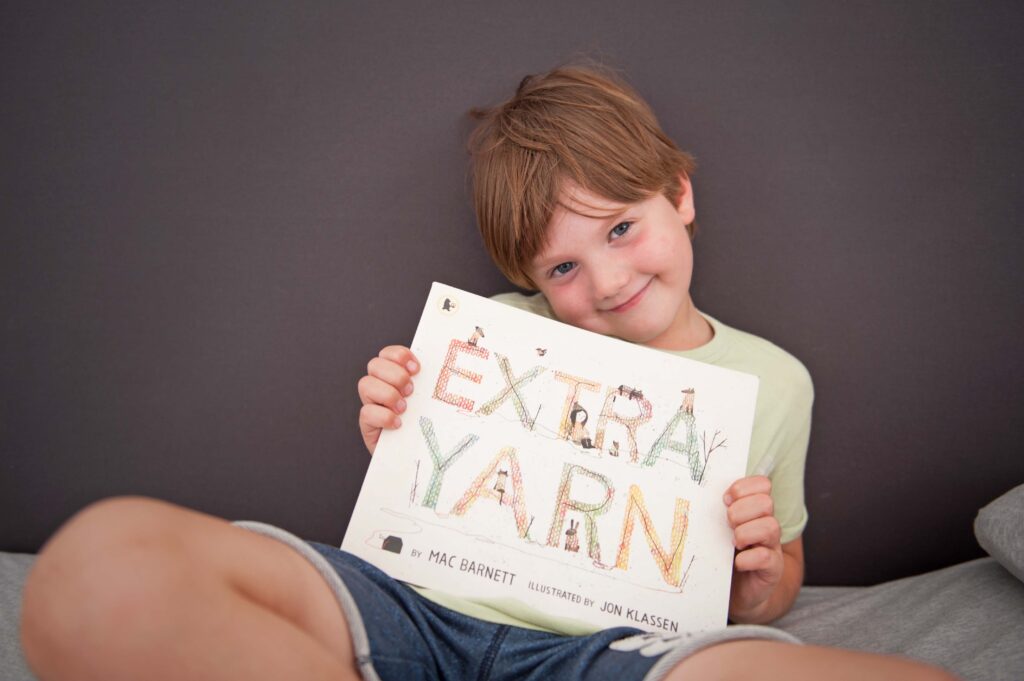
When my two boys were little, books were an everyday staple. They were happy to sit down for almost anything, but the clear favourites were either somewhat absurd or very funny. One they adored, and made me read hundreds of times, was Sam and Dave Dig a Hole by Mac Barnett, in which two boys decide to dig a hole until they find “something spectacular.” They near-miss increasingly enormous diamonds while digging, fall asleep, and then something unexpected and altogether bizarre happens (I won’t give spoilers). It doesn’t make full sense. Perhaps that’s partly the point. For my boys, it didn’t need to.
Another favourite was Do Not Open This Book, in which the narrating voice warns the reader, with increasing drama, not to turn the next page. My youngest cried with laughter every single time we read it – the fact that the element of surprise was gone after the first reading didn’t make his laughter any less. When I recently asked him (he’s a teenager now) if he remembers any picture books, that was the one that came to mind straight away.
Neither of those books fits the standard picture book protocol we are generally advised to follow as writers. There’s no clear story arc. There’s nothing to be learned. Nothing about them is realistic or relatable. But perhaps good children’s books don’t need to do any of those things. Perhaps they don’t need to make sense. Perhaps their main role is to delight children in ways that adults can struggle to understand.
“Adults often select picture books for themselves,” says librarian Rachel Bachman in her article What Children Actually Want from Picture Books. “They buy the book that reminds them of their own childhood, or the one with the gorgeous jacket, or the one written by a celebrity, or the one with such an admirable message that they can already picture the inscription they will write on the title page. They buy the book that makes them feel like the sort of adult who buys good books.”
So how big is the gap between what kids want and what adults buy – and produce? And what’s the shape of this chasm? Here’s my attempt to break it down.
1. Didacticism
According to Rachel Bachman, there’s one question that makes her “wince a little. It is the moment when a parent or caregiver tells me that the book their four-year-old keeps asking to hear is simply not good enough to deserve its popularity. They want, instead, a good book. A book that teaches something.”
She continues: to adults, “the opportunities for vocabulary-building or sneaking in some early science concept seem far too fertile to waste. We want books that feel obviously enriching in ways we can quickly quantify. Meanwhile, the actual child would like the pigeon to have another meltdown.”
In his recent book for adults about writing books for children, Make Believe, Mac Barnett (yes, the same Mac Barnett) calls didactic the “enemy of good storytelling” and points out that “children’s literature can be a refuge from the relentless paternalism of adults. The children’s book author is under no obligation to instruct or encourage or explain. Our only duty is to tell good stories.”
This isn’t to say education or difficult subjects have no place in children’s books. If books can gently help a child process grief, change, or fear, that’s a great thing, and something that shouldn’t be discounted. It’s just that lessons shouldn’t get in the way of a good story. The issue with didacticism, says Barnett, is that it “tends to warp narrative, flatten characters, and mar beauty. […] Plots bend toward the author’s point.” And ultimately, if we’re not delighting and entertaining and challenging children as writers, we’re not doing our job. “Even a story with a lesson should always be judged by how effectively that message is conveyed,” says Barnett, “not how worthy its message is or how important we think it is for kids to hear it. We can agree wholeheartedly with a book’s lesson and still deem it an artistic failure.”
There’s also a wider assumption that characters in children’s books need to behave a certain way. “I’ve met so many people who believe characters’ behaviour in children’s books should always be exemplary,” says Bachman, “lest readers emulate what they see in the story. This misunderstands children and stories. Kids don’t simply mimic what they see in books. And characters making terrible decisions is an engine of fiction and one of its chief delights.”
2. Humour
Adults often respond emotionally to books that are gentle, tender, about love and connection – the kind of book that makes a parent tear up while reading it aloud. Children, by contrast, overwhelmingly gravitate toward humour, gross-out content, and silliness.
“Humor first,” says Bachman, “because children are far less interested in our idea of a ‘lovely story’ than they are in whether something is actually funny. Not pleasantly amusing. Not sweetly charming. Funny. They like exaggeration. They like nonsense. They like stubborn characters making terrible choices with incredible confidence. They like embarrassment, catastrophe, repetition, and things getting increasingly out of hand. They like the kind of joke that gets bigger every time it comes around.”
Most adults have perhaps spent years training themselves out of exactly the kind of humour children love. We’ve learned to find subtlety funnier than slapstick, irony funnier than repetition, restraint funnier than chaos. Does writing genuinely funny children’s books means unlearning some of this?
In a 1988 documentary, Roald Dahl explained it simply: “My lucky thing is I laugh at exactly the same jokes as children laugh at. And that’s one reason I’m able to do it. I don’t sit here roaring with laughter, but you have wonderful inside chuckles all the time. And it’s got to be exciting, it’s got to be fast, it’s got to have a good plot, but it’s got to be funny. It’s got to be funny.”
3. Weirdness
Children love weirdness as much as they love silly humour, says Bachman. “Children are delighted by weirdness. They do not need every story to be realistic, emotionally restrained, or grounded in the tasteful logic adults keep trying to impose on children’s literature.”
Weirdness, she argues, is “not a flaw in a picture book. It is often the doorway in. It tells children this space is not governed by ordinary rules. It invites them to loosen up, to imagine, to laugh at things that would be impossible in real life. A strange book can feel more true to childhood than a realistic one, because childhood itself is full of intensity, absurdity, and giant feelings attached to very small events.”
It’s often the books that lean into the absurd that children return to again and again, and that prove to be genuinely memorable. As Janet Manley writes in her Lit Hub piece Let the Kids Get Weird: The Adult Problem With Children’s Books , “When you look back at the past, you can cherry pick the great books that took risks, said something original, and stood the test of time. But in any era, there were far more books that were boring, or dumbed down, or preachy, or sappy. Those are the books that, for the most part, are forgotten and go out of print.”
4. Format
Take any workshop on writing picture books, and you’re told what formula to follow. A picture book text should be around 500 words, it should have a clear beginning, middle, and end, with escalation in the middle. There should be no big words. The main character should have agency. (Lest kids think they don’t determine their own fate.) And obviously this isn’t wrong – there are plenty of brilliant books that follow all these rules. But are we missing out on some fabulous, creative, artistic books that children would adore by sticking to this blueprint too much?
Mac Barnett argues that children’s books should be complex, even hard to understand, and that when kids “encounter a story that makes demands of the reader – a story that requires thought and feeling and imagination in order to be fully understood – kids do what they do so well, so many times each day: They bravely work to comprehend the new.” They do this better than adults, Barnett argues; “Kids can exist in this in-between place full of uncertainty and porousness and ambiguity and all kinds of liminal stuff that dead dull finished grown-ups find difficult to endure.”
Going by my kids’ taste in picture books, this is true; they favoured the more bizarre, surreal stories over the ones that were more realistic and easier to dissect. They favoured the ones that were not held hostage by any kind of a formula. But the more abstract and complex a story is, the harder it might be to market. Publishers tend to want to say what a book is about, and what a child can take away from it in a clean few lines. A clear marketing pitch. As a writer, when you’re unable to do this, it can feel like you’re doing something wrong. But as Barnett puts it, “(y)ou can’t condense a story into a single sentence without doing great violence to it.”
5. Celebrities and prestige
Children’s books by celebrities have caused particular outrage in recent years. The “celeb-to-author pipeline,” as Ella Creamer and Lucy Knight wrote in a 2024 article in the Guardian, “is nothing new, [..] but the non-celeb side of the playing field has been hollowed out, with author incomes in decline. Authors say that stars wading into children’s publishing discredits the efforts and talents of non-celebrity authors. “Writing for children is an art,” says [Joshua] Seigal. “It requires skill, practice and discipline. I work really hard on my art, and it’s quite galling that people seem to think it is something that’s easy to do.””
The article continues to quote a bookshop owner who points out that buyers don’t necessarily care whether the book is good; “some are, some aren’t” – it’s “the name on the front that has got the sale.”
Kids do care if the book is good, and what they certainly don’t care about is who the author is. In most cases, they will have never heard of them, regardless of how famous they are.
Can we do better?
Children don’t have purchasing power, and they likely never will, so perhaps the gap between what kids want and what adults produce and buy will never be bridged. The entire chain of children’s publishing, from the writer’s desk to the bookshop shelf, runs through adult hands, adult taste, and adult judgement. It’s just economics.
But perhaps we can pay better attention to how kids reaction to different books, to which books get worn from re-reading, and to what those books actually do for our kids. We can try to project less of our own desires onto children’s books, and take kids seriously as readers.
As Mac Barnett puts it in Make Believe, “[i]t’s only right that adults think deeply about children’s literature. After all, we control the production, reception, and consumption of the books kids read. Take it from me: Children are terrible customers. They have no real income.”
Further reading:
Interview: Librarian Rachel Bachmann on what kids look for in books, how adults get this wrong sometimes, and how we might close this gap