On doodles, development, and knowing when something is right
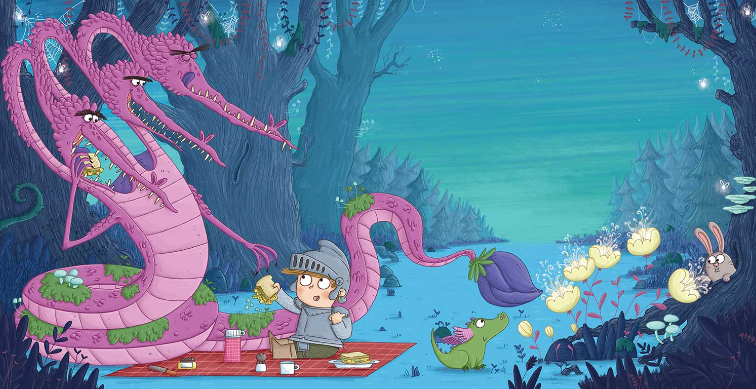
Ian Smith is a children’s book illustrator and author-illustrator represented by The Plum Agency. His illustrated titles include Wanna See a Penguin?, The King’s Runaway Crown, and The Day the Jungle-Net Broke. He also writes and illustrates his own books, among them The Very Polite Knight – a picture book he created for his son, featuring a knight who’d rather garden than fight, and a dragon called Dougal. We spoke to Ian about the text-image relationship, what happens when a five-year-old takes over your artwork, and why the image and the story are always in conversation with each other.
I think successful picture books are a perfect marriage between text and visuals. How much of a story is told through story, and how much through illustration, you think? And how do you get that balance right?
I fully agree! I think that picture books are a pretty special and unique medium as the pictures and the story have a magical relationship and the images and words can support each other in beautiful ways. As children’s stories are often limited in the word count per page, each word needs to be carefully chosen to bring the story to life. The images can then enhance that and add elements that would probably take too long to detail in words alone. The expression of a character can instantly show their reaction to the text, whereas writing that out could fill a whole page!
I believe that how much of the story is told through text or images can change from page to page. Some of the most impactful spreads I’ve done in stories have had almost no text at all, such as when the big bad monster appears for the first time and lets out a huge “ROOOOAAAARRR!” Equally, I’ve done really touching spreads where the lead character has been lost and it’s just them looking sad and alone on a white background with the text almost filling in all the gaps.
I think the best children’s books are created by authors and illustrators that realise and understand that they can trust in each others strengths in that way to create something really special.
When you receive a text, do you prefer to have very detailed illustration notes, or do you prefer to have more room for interpretation? What does an ideal brief look like?
Well, it’s always exciting to receive a new text! I’d normally read the story and the page layout notes at the same time to get a feel for how the author visualises things. It’s their story after all, and the final book is a partnership, so I’m normally pretty happy to start things off following whatever notes I’m given. I find that as the characters and the story develop in the pencil rough stage I might sometimes spot opportunities to design a page in a different way to give more visual impact, or add more depth. I’d then review that with the author to get their thoughts. Often just changing the placement of the text on the page can have a big impact on how the spread turns out.
I’m not sure I really have an ideal brief, as it usually just turns out to be a jumping off point. It comes back to that issue of having trust in each other and working together to create something greater than the sum of its parts.
How do you develop a character visually? Do you generally see it instantly in your mind, or is it a matter of gradual development?
For me it usually comes through development. It’s part of the process that I really enjoy, but can often be quite rapid. I tend to start off with some very loose and relaxed doodles, usually focusing on simple shapes that speak to the nature of the character. I’d then draw and re-draw multiple times until I start to spot elements then I think work and then carry them forward into the next version until the character just seems to pop into existence on the page and I just know that they’re right.
You have young kids – do you ever show them your work while it’s in development to get their opinion? Does their reaction ever surprise you? And has having kids yourself changed how you go about your work?
Yes, I have a young son and daughter and very often show them what I’m working on. Their opinions can be very surprising and often very insightful too! They have both been incredibly helpful in shaping the projects I’ve worked on. Occasionally, if I feel like I’m not getting anywhere with a particular image or character, they have come and sat with me at my desk and, as I work digitally, I’ve let them doodle all over the picture I’m working on, or had them draw their own version of the character right on the image. It can be really refreshing to have someone else come and show you how they think it should look. It can also be very freeing to have a five-year-old draw a completely unrelated choo-choo train all over a jungle themed book! It can help you stop getting too focused and precious about an image.
Do you have a favourite book or character out of all your work?
Well, I think it would have to be the knight character from The Very Polite Knight book that I wrote and illustrated for my son. It was a very personal book, as you can imagine, and featured all the things I love to draw the most like knights, monsters and dragons. Being able to create a whole book and then actually read it to both my kids is one of the most magical things I’ve ever done.
I’m currently working on a book for my daughter and I can’t wait to read that one at bedtime too.
There’s some anxiety about AI, both amongst writers and illustrators. How do you feel about this? Does it worry you?
I think that in some areas of the creative world AI might well be a threat, but for the world of children’s books I don’t think it’s an issue at the moment. For one thing, I don’t believe that people would want to read a story to their kids that was written and illustrated by AI. It can do some very impressive things but I think that reading a story to your kids at bedtime is a pretty special thing and reading an AI story would just feel too soulless.
You’re currently working on a book that you’re both writing and illustrating. How different does this make the illustration process?
Yes, the story for my daughter. It’s wonderful to be doing it for someone so special, so there is a lot of passion going into it. It’s the story of a girl trying to have a picnic in the jungle, but lots of animals keep turning up and asking her to share her food. The process has been really interesting as I’m creating it with a particular person in mind, so I’m adding in things that I know will make her laugh.
But the biggest difference is the way I’ve been developing it. I knew that I wanted to create a book for her, (especially as I’d already done one for my son!), but I didn’t have a particular story idea in mind, so I just sat down and started doodling her as the main character.
Then, as she loves cats, I started doodling a cat character on the same page, but I drew it a bit too big and it kind of turned out to look more like a tiger. That then started to give me an ideas for stories. Where had she met this tiger? Was he friendly or fierce?
The image had prompted some story ideas, so I started drafting some different plot lines out. That in turn started to generate ideas for other characters. So I’d go back and doodle some of the characters. I kept going backwards and forwards with the characters’ images influencing the story idea and then the development of the story influencing the character development until I had a complete set of characters and a full story.
I guess it all circles back to that first question of how much of a story is told through story, and how much through illustration? For me, it just shows how one can have an effect on the other and that they can both work in harmony to create something incredible.
Ian Smith is represented by The Plum Agency. You can view his portfolio at theplumagency.com/illustrators/ian_smith.